Reader Monad
Alexandre Bergeron
Backend Developer @Wajam
@AlexBergeron2
Scala Montreal
March 26th, 2014
An introduction
def getUsers(): List[User] = {
  val c = Database.getConnection()
  try {
    val rs = c.executeQuery("SELECT * FROM Users")
    User.fromResultSet(rs)
  } catch {
    case t => Nil
  } finally {
    c.close()
  }
}
Extracting connection handling logic
def getUsers(c: Connection): List[User] = {
  try {
    val rs = c.executeQuery("SELECT * FROM Users")
    User.fromResultSet(rs)
  } catch {
    case t => Nil
  }
}
Using it
// Giving a user admin rights
val c = Database.getConnection()
try {
  val u = getUserById(id, c)
  updateUser(id, u.copy(rights = u.rights + Rights.Admin), c)
} finally {
  c.close()
}
Dependency injection using implicits
implicit val c = Database.getConnection()
try {
  val u = getUserById(id)
  updateUser(id, u.copy(rights = u.rights + Rights.Admin))
} finally {
  c.close()
}
Ideal solution
- Easy to compose
- Could delay handling of connection as late as possible
- Avoids polluting the code with implicits
- Avoids complex dependency injection frameworks
Contents
- What is a Monad
- What is a reader monad
- Use cases
What is a Monad
Tutorials about monads
- There are way too many Monads tutorials available
- Don't take this talk as a good formal introduction to Monads
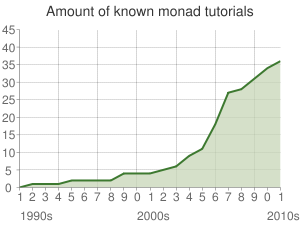
(Monads Tutorial timeline - http://www.haskell.org/haskellwiki/Monad_tutorials_timeline)
What a Monad is not
- A burrito (http://blog.plover.com/prog/burritos.html)
- The most primal aspect of God in Gnosticism (http://en.wikipedia.org/wiki/Monad_(Gnosticism))
- Overly complex mathematical concept only Haskellers find usefull
You're (probably) already using Monads
- (most) Collections, Option, Future
- Iteratees, Reactive Observables
- ScalaCheck Generator
- Anytime you're using for comprehensions, you're doing Monad composition
Monads in Scala
(Simplified for the sake of this talk)
- A type M with a type parameter A
- Exposes
map[B](f: A => B): M[B]flatMap[B](f: A => M[B]): M[B]
Reader Monad
Basic Idea
- Allows for composition of functions taking a parameter of the same type
- "Reads" a value a provides it to the functions it composes
Implementation
case class Reader[C, A](private run: C => A) {
  def apply(c: C): A = run(c)
  def map[B](f: A => B): Reader[C, B] =
    Reader(c => f(run(c)))
  def flatMap[B](f: A => Reader[C, B]): Reader[C, B] =
    Reader(c => f(run(c))(c))
}
Monadified example
def getUsers = Reader[Connection, List[User]](c => try {
  val rs = c.executeQuery("SELECT * FROM Users")
  User.fromResultSet(rs)
} catch {
  case t => Nil
})
Monadified example
def getUserById(id: Int): Reader[Connection, User]
def updateUser(id: Int, u: User): Reader[Connection, Unit]
def grantAdmin(id: Int): Reader[Connection, Unit] = {
  getUserById(id) flatMap { u =>
    updateUser(id, u.copy(rights = u.rights + Rights.Admin))
  }
}
// Same Connection passed to getUserById then to grantAdmin

grantAdmin(id)(Database.getConnection())- Composable
- Explicit dependency
- Avoids polluting the implicit namespace
- Framework-less
- Data-flow driven
Possible problems
- Style not as familiar (to some) as traditional OO Code
- Composing with other Monads is difficult
- See Monad Transformers
- Composition requires for comprehensions or flatMapping - Losing simple functions
Use cases
- Passing a common configuration to your code
- Inversion of control
- Simple Dependency injection
More about Reader Monads
- Dead-Simple Dependency Injection by Rúnar Óli Bjarnason - https://www.youtube.com/watch?v=ZasXwtTRkio
- Reader Monad Purpose - http://stackoverflow.com/questions/14178889/reader-monad-purpose
- Reading your Future by Dan Rosen - http://mergeconflict.com/reading-your-future/
- learning Scalaz - Reader by Eugene Yokota - http://eed3si9n.com/learning-scalaz/Reader.html
- Control.Monad.Reader in Haskell - http://hackage.haskell.org/package/mtl-1.1.0.2/docs/Control-Monad-Reader.html
Questions?
Thanks for listening
Made with Pandoc, Markdown and reveal.js